

close
Choose Your Site
Global
Social Media

 |


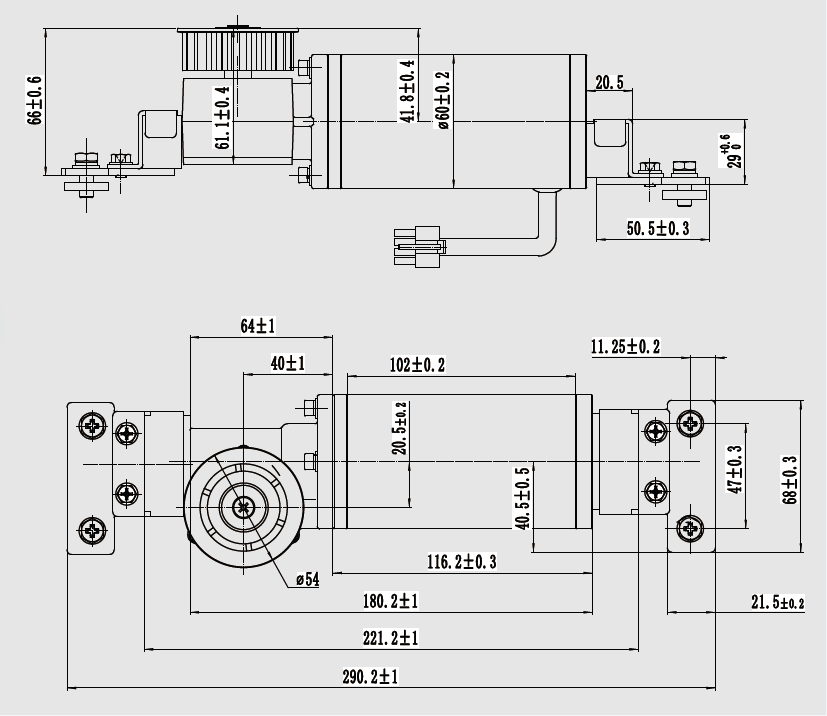
YFT150/6——YFT120C/12
start-motors
061
| Quantity: | |
|---|---|
| |||
| Product name | 6 slots triangular Motor | Rated Current | 2.5A |
| Model | YFS150/6 | Rated Speed | 2300RPM |
| Color | Aluminum alloy Nature, Black, Customize | On-load speed | 144RPM |
| Number of stator slots | 6 | Gear Ratio | 1:16 |
| Magnetic Poles | 4 pairs | Rated torque with Gearbox | 0.45Nm |
| Motor Pulley | S8M powder matallurgy | Stall Torque without Gearbox | 0.65N.m |
| Rated Voltage | DC24V | Motor Socket | JST/ELP-09V |
Rated Power | 60W | IP Level | IP54 |
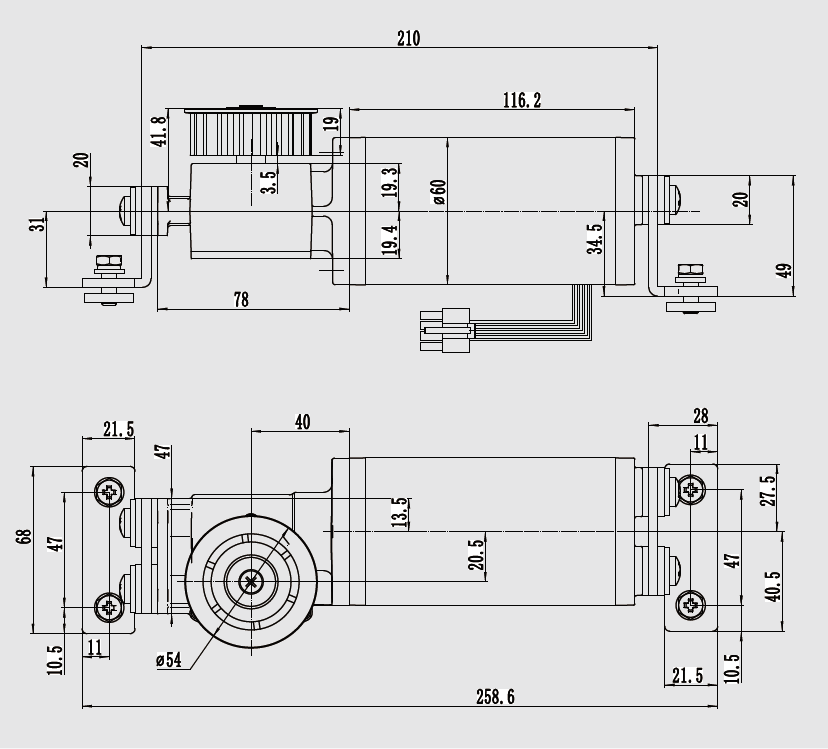
2、Model:YFT120C/12 | |||
| Product name | 90 type triangular motor | Rated Current | 2.1A |
| Model | YFT120C/12 | Rated Speed | 2600RPM |
| Color | Silver with slots | On-load speed | 163RPM |
| Number of stator slots | 12 | Gear Ratio | 1:16 |
| Magnetic Poles | 4 pairs | Rated torque with Gearbox | 0.35Nm |
| Motor Pulley | S8M powder matallurgy | Stall Torque without Gearbox | 0.5N.m |
| Rated Voltage | DC24V | Motor Socket | JST/ELP-09V |
Rated Power | 50W | IP Level | IP54 |
Common Technical Issues with Brushless Automatic Door Motors (BLDC)
(一)The motor won't start / it shakes and buzzes when powered, can't open the door
1. Hall Sensor Failure (Most Common)
Symptoms: Vibrates or buzzes when powered on, needs a manual push to start turning; sometimes it starts, sometimes it doesn't.
Causes: Abnormal 5V supply to Hall sensor, loose connector due to vibration, damaged Hall element, incorrect Hall phase wiring. Brushless motors rely on Hall sensors for commutation, so any Hall issue directly causes phase loss.
Checks: Resistance between each pair of the three-phase power lines should be roughly the same; measure the three Hall signals while turning the shaft, all three should alternate between high and low.
2. Winding Phase Loss / Inter-turn Short / Disconnection
Symptoms: Buzzing with low power, high current, heats up quickly. Measure U/V/W three-phase resistances with a multimeter; if values are unbalanced, it’s a winding issue.
3. Mechanical Jam or Overload
Wheel jammed, track deformed, belt too tight, door too heavy, foreign objects stuck. First, manually push or pull the door to check mechanical resistance.
4. Power Supply and Wiring
Large voltage drop on 24V supply, insufficient wire gauge, reversed power and Hall signal lines, loose terminals.
5. Controller Drive Transistor Damage
Motor itself is fine, but the driver MOSFET failed, so there’s no output.
(二). Lagging operation, intermittent shutdown, sudden stops
1. Hall harness loose connection / vibration signal break: The door shakes back and forth, connector pins make poor contact, Hall signal is lost during operation, the controller triggers protection and shuts down, and after power cycling it works briefly.
2. Overcurrent protection: Door operation becomes harder, current exceeds the limit, controller shuts down to protect.
3. Overtemperature protection: Frequent long-term door opening/closing, poor heat dissipation, motor temperature exceeds limit, automatically shuts down and recovers after cooling.
4. Partial demagnetization of permanent magnets: Long use, high temperature impact, torque fluctuates a lot, low-speed section jumps.
5. Encoder abnormality (for encoder models): Position feedback loses pulses, causing misalignment and incorrect positioning.
(三). Strange Noise and Strong Vibration
1. Bearing Damage: Periodic clicking or rumbling friction sounds, dried-out grease, pitting. Most noticeable at low speed; a common mechanical issue.
2. Gearbox Problems: Worn gears, too much clearance (backlash), lack of oil, strong impact vibration when the door closes fully.
3. Poor Rotor Balance or Misaligned Axis: Vibration obvious at high speed.
4. Tuning Parameter Issues: PI parameters set improperly, causing start-stop oscillation, door shaking; not a hardware problem with the motor itself.
(四). Motor Overheating Problems
Overload: The door is too heavy, the track resistance is high, or the trolley wheel is stuck, causing continuous high current.
Voltage deviates from the rated value, and the power supply is unstable.
Slight short circuits between winding turns, increasing losses.
High start-stop frequency (like in busy shopping areas), duty cycle exceeds limits.
Normal temperature rise ≤60K; if the casing stays above 85℃ for a long time, it's abnormal and can speed up permanent magnet demagnetization and insulation aging.
(五). Abnormal Speed: Door opening/closing speed is off, low-speed shaking, big impact when done
1. Controller parameter tuning problems (most common)
Acceleration, deceleration, and cushioning segment parameters are not suitable; deadband time or PWM frequency settings are wrong, causing low-speed shaking.
2. Hall phase direction set incorrectly: opening and closing speeds are uneven, direction reverses. Just reset the Hall direction parameters to fix it; the motor itself is fine.
3. Supply voltage drop: Voltage drops when current is high, preventing the top speed from being reached.
4. Belt slipping or unstable load, making the speed seem fast and slow.
(六). Anti-pinch and torque problems, can’t push / reverses on touch
1. Torque threshold parameter set wrong: if torque is too low, even slight resistance triggers reversal; if torque is too high, anti-pinch fails, posing a safety risk.
2. Current sensing abnormality (controller), can’t correctly detect stall current.
3. Hall/encoder position feedback inaccurate, leading to wrong stall recognition.
Please contact our sales team for details regarding model naming.
info@start-motors-tech.com (Mr.Louis)


